[x]Blackmoor Vituperative

Tuesday, 2015-01-27

Raise the minimum wage to $15/hr

Filed under: Philosophy,Society — bblackmoor @ 09:20

I think people who persist in clinging to theories that have been soundly refuted by facts should not be called “economists”: they should be called “philosophers”. The consensus among economists is that raising the minimum wage has little or no effect upon employment — because the evidence demonstrates that it does not. The reasons why that is the case are varied, but a major one is that at the lowest-paid end of the employment spectrum, the demand for labor is inelastic. If it takes three people to perform a task, paying them $10/hr won’t make the task require fewer people.

Employment vs increased minimum wage

The chart above shows the results of more than 1,400 different studies. The x-axis shows the size of the employment effect, and the y-axis shows that statistical power of the analysis.

The results have clustered around the finding that a moderate wage increase — in line with the administration’s proposal to increase the minimum rate in 95-cent increments — has zero effect on total employment. And the higher a study’s statistical power, the more likely it is to fall on the line showing zero effect.

“I really think that’s a very compelling takeaway,” said Hall, who has testified before multiple state legislatures on the issue. “It puts the lie to the notion that it’s going to be a tremendous job killer.”

(From 1,400 Real World Minimum Wage Increases Show No Impact on Employment, Fiscal Times

Personally, I would go with $15/hr. There is no reason in the world that taxpayers should be footing the bill to make up for the below-subsistence wages paid by employers like Wal-Mart (Report: Walmart Workers Cost Taxpayers $6.2 Billion In Public Assistance). Increase the minimum wage to a responsible level and put the cost of doing business on the business, where it belongs.

Systematically oppressing the bulk of a population is not only morally indefensible, but terribly short-sighted. There are not enough firearms in this country to protect the rich (or just the reasonably comfortable) from the poor, if the poor decide they’ve had enough. Personally, I’d favor raising the minimum wage to $15/hr, eliminating loopholes that allow employers to pay even less than the minimum wage, and then pegging it to the Consumer Price Index (although someone should take a close look at how CPI is calculated to make sure that’s not being manipulated).

Saturday, 2014-11-29

Ten Secular Commandments

Filed under: Philosophy — bblackmoor @ 09:48
ReThink Prize

The ReThink Prize is offering $1,000 each for the ten best secular commandments, as determined by a panel of judges. The prize is promoting a new book, Atheist Mind Humanist Heart, which promotes a vision of atheism as positive and ethical rather than negative and reactive. Here are ten “commandments” I thought of, although I did not bother submitting them for the contest. It’s just a thought experiment.

  1. Be kind to everyone, even when your kindness is not reciprocated.
  2. Seek the company of people who appreciate and inspire you.
  3. Avoid confrontation, and those who seek it, when possible.
  4. Defend yourself and others with violence, when necessary, but take no joy in it.
  5. Be generous, even when there is no possibility of your generosity being reciprocated.
  6. Do not take what is not freely offered.
  7. Be useful, to the best of your ability.
  8. Create something beautiful, to the best of your ability.
  9. Be worthy of the trust of others.
  10. Be true to yourself.

I think that’s a pretty good list, but I don’t think it’s terribly innovative. Desiderata is better.

If I could have gone to eleven, I would have added something about being a good steward for nature, but I ran out of commandments.

Thursday, 2014-06-12

Musings on a power outage

Filed under: Home — bblackmoor @ 10:07

The power has been out about five hours as I write this. I’m conserving my laptop battery, and I hope it lasts until power is restored.

I’m glad it’s cool out. I can’t bear the heat. If it warms up later, I’ll have to go down into the basement, or get in my car and drive somewhere. I don’t want to spend any money, though, and I know if I drive around, I’ll be tempted to buy a hamburger or an egg McMuffin or something. I can’t make coffee or even a bowl of cereal. So far I have had a couple of bananas, the last few Oreos, and a couple of glasses of warm cola. Breakfast of champions.

I have been trying to think of things do that don’t require electricity. I have our Red Cross radio on some local “classic rock” station. Dirty Deeds Done Dirt Cheap, Teenage Wasteland, that sort of thing. There is a lot of yard work I would like to do, but between everything being wet from the storm and my not having any way to clean up afterward (we have well water, so no power means no water), I probably won’t be doing yard work today.

However, there are things I can do. For example, I have been straddling two different laptop bags for over a year now. Yes, that’s ridiculous. It’s just been really low on my to-do list. But now I have gone through all of pouches and pockets of my old laptop bag, tossed a lot of things I never used (or just plain garbage), and moved the rest to various pouches in the new laptop bag. So hooray, I’ve accomplished something. That took the better part of an hour, if you include the time I have spent playing with Vixen.

I’ve also been playing with Vixen, of course. She seems to sense that something isn’t quite right, but she’s been making the most of it, batting around and chasing the odd little gizmos I pulled out of my old laptop bag but hadn’t yet thrown away or put into the new laptop bag. Now she’s taking a break and lounging on my calves.

I think I may tackle the pile of paperwork that’s been piling up on my desk. Old receipts, work orders from repair work on our house, that sort of thing.

Oh, hey! The power just came back on! Yay! Now I can spend the next two hours reading Facebook….

[ten minutes later]

And now the power’s back off. I had ten minutes of power, and I wasted it on Facebook (what, you thought I was kidding?). Well, when the power comes on again (if it does), I certainly won’t be wasting it! The first thing I will do is make a pot of coffee. After that, I will read my email. After that… I’m not sure.

I guess I will go ahead and sort out those papers now.

[later]

The power is on, I have a hot cup of coffee, and I am making a dent in these papers.

Monday, 2014-03-03

Ruminations on web design and system administration

Filed under: Programming,Work — bblackmoor @ 10:18

Now that the Kickstarter is over, I can go back to talking about other things. For example, how happy I am that I am no longer working in web design. The work I would like to do, in decreasing order of preference, is:

  • system administration
  • database administration
  • back-end programming (i.e., not Javascript)
  • project management
  • front end programming (i.e., Javascript)
  • web design

There are reasons why web design is at the bottom of the list. The biggest one is that the people who pay to have that done are too often operating under the false assumption that they know how to do it, and that they just need someone else to do the grunt work of actually using the software. Oatmeal has a pretty funny cartoon on what that’s like for a web designer.

That’s an exaggeration, of course. I am lucky that back when I did web design as my primary profession, I very rarely had clients quite that clueless. A more frequent occurrence was the “we need to Do Something” problem. Smashing Magazine has a pretty decent article on that, but if you have been a user of YahooGroups or FaceBook for any length of time, you have seen that phenomenon in action.

System administration is at the top of the list for even better reasons. For one thing, I simply enjoy it. I like making things work. It’s like working on a car and getting it to run smoothly, but you don’t bang your knuckles or get your hands dirty. Also, success is generally objective: if the system works, that’s success. None of the “that color is too aggressive” type feedback you get when doing web design (I actually had a client say that phrase to me). Of course, there are some subjective measurements of success, even in system administration. For example, you can continue throwing time and money at a database server to increase performance, and the point at which the performance is good enough is a subjective call. Even so, generally speaking, the line between “working” and “not working” is pretty clear. I like that.

Monday, 2014-02-17

Happy Epicurus’ Birthday!

Filed under: Fine Living — bblackmoor @ 22:42
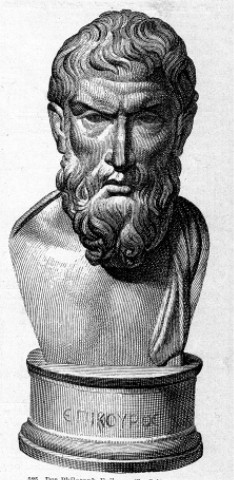
Bust of Epicurus

I celebrate Epicurus’ Birthday on the third Monday of February, in honor of the philosopher Epicurus, the ancient Greek philosopher and the founder of the school of philosophy called Epicureanism. His school was the first of the ancient Greek philosophical schools to admit women as a rule rather than an exception.

For Epicurus, the purpose of philosophy was to attain the happy, tranquil life, characterized by ataraxia—peace and freedom from fear—and aponia—the absence of pain—and by living a self-sufficient life surrounded by friends. He taught that pleasure and pain are the measures of what is good and evil; death is the end of both body and soul and should therefore not be feared; the gods do not reward or punish humans; the universe is infinite and eternal; and events in the world are ultimately based on the motions and interactions of atoms moving in empty space.

(From Epicurus, Wikipedia)

Wednesday, 2014-01-08

Pay attention, this is your life you are missing

Filed under: Fine Living,Friends — bblackmoor @ 18:57

Pay attention to the people around you. Your life is ticking away, minute by minute, and when they’re gone, you’re gone. Don’t waste your life staring at an object in your hand.

For myself, I am going to attempt to spend my time more wisely, with a greater awareness of who and what I am paying attention to.

Saturday, 2013-11-23

Accounting for Kickstarter

Filed under: Gaming,The Internet,Work — bblackmoor @ 19:47
Wallet

When it comes to accounting for the money raised through Kickstarter etc., most people seem aware of the 5% Kickstarter fee, the ~4% Amazon fee, the 1%-5% billing failure, and the potential for as much as 10% to be lost in chargebacks. What I don’t see many people mentioning is the amount of income tax the IRS is going to take of the amount raised (if you are a US citizen). In Europe, you may have VAT, which is even more complicated. Established businesses already know about this, of course, but since many people who start a Kickstarter campaign are hobbyists and startups, I thought this was a worthwhile thing to point out: keep taxes in mind when you are estimating how much you will need to raise to complete your project.

Wednesday, 2013-11-13

Remembering Xanadu

Filed under: Programming,The Internet,Work — bblackmoor @ 23:05
Xanadu

I was reminded recently of an interesting article from the June 1995 issue of Wired magazine. I subscribed to Wired back then: this was during the early days of the internet, while the 1990s tech bubble was inflating like gangbusters. The article is “The Curse of Xanadu“, by Gary Wolf.

It was the most radical computer dream of the hacker era. Ted Nelson’s Xanadu project was supposed to be the universal, democratic hypertext library that would help human life evolve into an entirely new form. Instead, it sucked Nelson and his intrepid band of true believers into what became the longest-running vaporware project in the history of computing – a 30-year saga of rabid prototyping and heart-slashing despair. The amazing epic tragedy.

The article begins with a brief description of the mind behind Xanadu, Ted Nelson. He is described as a very smart man with many ideas, but who has difficulty finishing his projects. Later in the article, we learn that Nelson has an extreme case of Attention Deficit Disorder.

The article then goes on to describe the goals of the Xanada project, which Nelson began working on in 1965:

Xanadu was meant to be a universal library, a worldwide hypertext publishing tool, a system to resolve copyright disputes, and a meritocratic forum for discussion and debate. By putting all information within reach of all people, Xanadu was meant to eliminate scientific ignorance and cure political misunderstandings. And, on the very hackerish assumption that global catastrophes are caused by ignorance, stupidity, and communication failures, Xanadu was supposed to save the world.

Yet Nelson, who invented the concept of hypertext, is not a programmer. He is a visionary. He is also appearently immensely persuasive. He convinced people to spend millions of dollars on Xanada (long before the tech bubble made that irrational behaviour seem normal), and years working on it. And it does seem that Nelson was a true visionary. In 1969, he already foresaw that technology would “overthrow” conventional publishing, and that paper would be replaced by the screen (in his mind, it already had). But he was limited by the technology of his day. “Even [in 1995], the technology to implement a worldwide Xanadu network does not exist.” In the 1970s, “[the] notion of a worldwide network of billions of quickly accessible and interlinked documents was absurd, and only Nelson’s ignorance of advanced software permitted him to pursue this fantasy.”

In the early 1970s, Nelson worked with a group of young hackers called the RESISTORS, in addition to a couple of programmers he had hired. During this period, the first real work on Xanadu was accomplished: a file access invention called the “enfilade”. What the enfilade is or exactly what it does is a mystery: unlike another famous iconoclast, Richard Stallman, Ted Nelson did not believe that “information wants to be free”. The nature of Xanadu’s enflilade, what it does, and how it is implemented is a mystery: everyone who has worked on the project has been sworn to secrecy.

In 1974, Nelson met programmer and hacker Roger Gregory. According to the article, if Nelson is the father of Xanadu, Roger Gregory is its mother. “Gregory had exactly the skills Nelson lacked: an intimate knowledge of hardware, a good amount of programming talent, and an obsessive interest in making machines work. […] through all the project’s painful deaths and rebirths, Gregory’s commitment to Nelson’s dream of a universal hypertext library never waned.” Gregory’s tale is a sad one: it’s difficult to see his involvement in Xanadu as anything other than a tragic waste of his life.

As the years go by and the 1970s become the 1980s, Nelson continued to work on Xanadu, and Xanadu continued not to be completed. By the late 1980s, the project team had dwindled and support for it was difficult to find. Nelson and Gregory would not admit failure, although Gregory struggled with thoughts of suicide. However, in 1988 Xanadu was rescued by John Walker, the founder of Autodesk. It seemed that Xanadu would at last have the benefit of serious commercial development. “In 1964,” Walker said in a 1988 press release, “Xanadu was a dream in a single mind. In 1980, it was the shared goal of a small group of brilliant technologists. By 1989, it will be a product. And by 1995, it will begin to change the world.”

It turned out that was easier said than done.

I find it interesting that one of the technical obstacles to Xanadu’s development was due to its profoundly non-free approach to the information it would make available.

The key to the Xanadu copyright and royalty scheme was that literal copying was forbidden in the Xanadu system. When a user wanted to quote a portion of document, that portion was transcluded. With fee for every reading.

Transclusion was extremely challenging to the programmers, for it meant that there could be no redundancy in the grand Xanadu library. Every text could exist only as an original.

In my opinion, this philosophy of restricting information is a key reason that Xanadu failed.

By the early 1990’s, control of the project shifted away from Gregory and the original development team, and all of the existing code was discarded. This also made Walker’s 18-month timeline explicitly unattainable.

John Walker, in retrospect, blames the failure of Xanadu on the unrealistic goals of the (new) development team.

John Walker, Xanadu’s most powerful protector, later wrote that during the Autodesk years, the Xanadu team had “hyper-warped into the techno-hubris zone.” Walker marveled at the programmers’ apparent belief that they could create “in its entirety, a system that can store all the information in every form, present and future, for quadrillions of individuals over billions of years.” Rather than push their product into the marketplace quickly, where it could compete, adapt, or die, the Xanadu programmers intended to produce their revolution ab initio.

“When this process fails,” wrote Walker in his collection of documents from and about Autodesk, “and it always does, that doesn’t seem to weaken the belief in a design process which, in reality, is as bogus as astrology. It’s always a bad manager, problems with tools, etc. – precisely the unpredictable factors which make a priori design impossible in the first place.”

In 1992, just before the release of Mosaic and the popularization of the World Wide Web, Autodesk crashed and burned, and the pipeline of funding that kept the Xanadu project going came to an end. Ownership of Xanadu reverted to Ted Nelson, Roger Gregory, and a few other long-time supporters.

A glint of hope appeared. Kinko’s (remember Kinko’s?) was interested in funding the project for their own use. But Nelson chose this time to attempt to seize control of the project. The programmers who had been subjected to Nelson’s attention-deficit management style resisted. Again, Nelson’s desire for control was destructive to the accomplishment of his dream. “By the time the battle was over, Kinko’s senior management had stopped returning phone calls, most of Autodesk’s transitional funding had been spent on lawyers fees, and the Xanadu team had managed to acquire ownership of a company that had no value.”

There was a brief respite from an insurance company, but that too soon ended in failure. After not being paid for six months, the last few developers took the hardware and quit. “With the computers gone, Xanadu was more than dead. It was dead and dismembered.”

As of 1995 (the date of the article), Nelson was in Japan, still pushing his idea of “transclusion”, still hostile to the very freedom and chaos that has made the World Wide Web the enormous success it is. I think he’s a perfect example of how someone can be both brilliant and utterly clueless.

In 2007, Project Xanadu released XanaduSpace 1.0. There is a video on YouTube of Ted Nelson demonstrating XanaduSpace. As far as I know, that was the end of the project.

Some other links that you might also find of interest:

http://xanadu.com/

http://xanadu.com.au/

http://www.wired.com/wired/archive/3.09/rants.html

http://www.xanadu.com.au/ararat

http://www.theatlantic.com/magazine/archive/1945/07/as-we-may-think/303881/

http://web.archive.org/web/20090413174805/http://calliq.googlepages.com/”Xanadu Products Due Next Year”

https://archive.org/details/possiplexvideo

Friday, 2013-11-01

Happy Vixen

Filed under: Family — bblackmoor @ 12:50
Happy Vixen

Someone is really happy to have her cone off. 🙂 It’s an animated GIF: click the image to see it full size.

Thursday, 2013-08-22

8th Annual Blackmoor Halloween Party

Filed under: Family,Friends — bblackmoor @ 20:52
Scary!

You may have been cordially invited to the 8th Annual Blackmoor Halloween Party! If so, keep reading. If not, avert your eyes!

Costumes are encouraged! Snacks, drinks, and Halloween Chili will be provided. If you have special dietary needs or are prone to complain about what is offered, bring your own.

You may bring guests and/or children, but you are responsible for their behavior.

We have abundant amounts of room, including a couple of private rooms. Regardless of where you sleep, you will need to bring your own bedding (such as a sleeping bag or inflatable mattress). You may also reserve a room at the nearby Best Western Plus Crossroads Inn & Suites.

Please RSVP, so that we can plan appropriately. Thanks!

When:
6 PM, Saturday, November 2, 2012
Let us know if you want to arrive early!

Where:
Castle Blackmoor
70 Starling Ln.
Troy, VA 22974-3278

« Previous PageNext Page »